September 17, 2026
Gas turbines and turbomachinery operate in demanding environments where clean intake air is essential. Dust, sand, pollen, salt, oil mist, and other airborne contaminants can enter the air intake system and affect equipment performance.
A reliable compact filter, especially a V-panel air filter, can help protect gas turbines, compressors, and other turbomachinery while maintaining stable airflow and a reasonable pressure drop.
For power plants, industrial facilities, oil and gas operations, and other energy applications, choosing the right gas turbine air filter is an important part of maintaining reliable equipment operation.
In this guide, we explain what compact V-panel filters are, how they work, where they are used, and what buyers should consider when selecting a filter for gas turbines and turbomachinery.
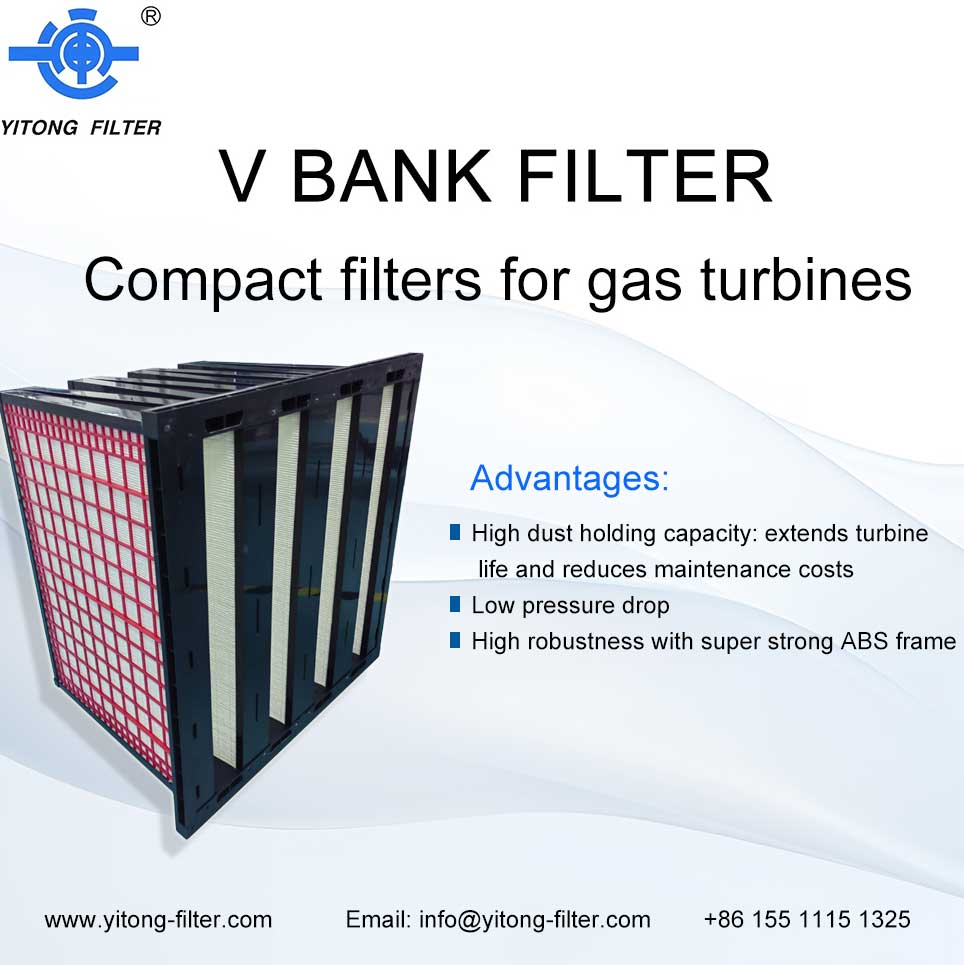
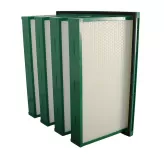
A compact V-panel filter is a high-capacity air filter designed with multiple filter media packs arranged in a V-shaped configuration inside a rigid frame.
Compared with a traditional flat panel filter, the V-panel design provides a larger effective filtration area within a relatively compact footprint.
This design offers several practical advantages:
Large filtration area
High air-handling capacity
Compact installation dimensions
Relatively low pressure drop
Good dust-holding capacity
Stable mechanical structure
Suitable for continuous industrial operation
Because of these characteristics, V-panel filters are commonly used in gas turbine air intake systems, compressors, HVAC systems, air handling units, and other industrial ventilation applications.
The actual filter performance depends on the filter media, dimensions, air velocity, frame design, sealing method, and operating conditions.
A gas turbine continuously draws a large volume of atmospheric air into the system. In many industrial environments, this air contains a significant amount of airborne particles.
Depending on the location, contaminants may include:
Dust
Sand
Pollen
Industrial particles
Salt aerosols
Oil mist
Moisture
Smoke
Fine particulate matter
If these contaminants are not effectively controlled, they can accumulate on components inside the turbine or affect downstream equipment.
A properly designed gas turbine intake air filterhelps reduce the amount of airborne contamination entering the equipment.
This can contribute to:
The primary purpose of an intake filter is to protect downstream components from airborne contaminants.
A suitable filtration system can reduce particle loading on sensitive turbine components and help maintain cleaner operating conditions.
Gas turbines require a consistent supply of intake air. Excessive filter resistance can increase pressure loss across the intake system.
A properly selected filter balances filtration efficiency with airflow resistance.
Contaminant buildup can increase cleaning and maintenance requirements. Effective pre-filtration and final filtration can help reduce the amount of particulate entering the turbine system.
Stable filtration performance is especially important for equipment that operates continuously or for long periods.
For this reason, filter selection should consider the actual operating environment rather than relying only on nominal filter efficiency.
The basic working principle is straightforward.
Air enters the filter from the upstream side. As the air passes through the filter media, airborne particles are captured by the media.
The filtered air then passes into the clean-air section and continues toward the gas turbine or turbomachinery.
The V-shaped configuration creates multiple filtration surfaces inside one filter housing.
Instead of increasing the external dimensions of the filter, manufacturers can increase the effective filtration area by folding or arranging the media into multiple panels.
This allows a compact filter to handle a relatively high airflow rate.
Different manufacturers offer different constructions, but a typical industrial V-panel filter may include the following components.
The media is responsible for particle capture.
Depending on the required filtration level, the filter may use synthetic, fiberglass, or other engineered filtration media.
The appropriate media depends on the application, particle characteristics, required efficiency, and operating environment.
The frame supports the filter media and allows the filter to be securely installed inside the intake housing.
Common frame materials include galvanized steel, plastic, aluminum, or other materials selected according to the application.
The media packs are arranged in a V configuration to maximize filtration area.
This is one of the main differences between a compact V-panel filter and a conventional flat filter.
Proper sealing is essential in gas turbine intake systems.
A filter can have high-efficiency media, but poor sealing around the filter frame may allow unfiltered air to bypass the media.
Therefore, the gasket, frame, and housing interface should be considered together.
A traditional flat panel filter has a relatively simple construction and is suitable for many general ventilation applications.
However, gas turbine intake systems often require higher airflow capacity within a limited installation space.
The V-panel configuration provides more filtration area without requiring a proportionally larger external filter.
Here is a simple comparison:
| Feature | Traditional Panel Filter | Compact V-Panel Filter |
|---|---|---|
| Filtration area | Moderate | High |
| Airflow capacity | Moderate | High |
| Space utilization | Standard | Efficient |
| Dust-holding capacity | Depends on design | Often higher |
| Structure | Simple | Multi-panel construction |
| Industrial applications | General HVAC | Gas turbines, turbomachinery, HVAC and industrial systems |
The right choice still depends on the airflow requirements and the design of the existing intake system.
Compact V-panel filters are used in a wide range of industrial applications.
Gas turbines are one of the most important applications.
The filter is installed in the air intake system to remove airborne particles before the air enters the turbine.
Applications include:
Power generation
Combined-cycle power plants
Industrial gas turbines
Distributed power generation
Oil and gas facilities
Energy infrastructure
The filter specification should be selected according to the turbine model, intake airflow, environmental conditions, and existing filter housing.
Industrial compressors also require clean intake air.
V-panel filters can be used in compressor air intake systems where high airflow and effective particle filtration are required.
This is particularly relevant in:
Oil and gas facilities
Petrochemical plants
Industrial production
Process plants
Energy facilities
The term turbomachinery covers a wide range of rotating equipment, including turbines and compressors.
Because these machines often handle large volumes of air or gas, the intake filtration system needs to provide sufficient airflow while controlling particulate contamination.
Compact filters can be an efficient solution when installation space is limited.
One of the most important specifications when purchasing a gas turbine air intake filter is pressure drop.
Pressure drop is the resistance created as air passes through the filter.
A dirty filter normally has a higher pressure drop than a new filter because accumulated particles restrict airflow through the media.
For gas turbine applications, pressure drop should be considered together with:
Airflow rate
Filter efficiency
Filter dimensions
Media type
Dust concentration
Operating hours
Ambient conditions
Filter loading characteristics
A filter should not be selected based on efficiency alone.
For example, choosing a filter with a very high efficiency but unsuitable airflow characteristics may not provide the desired overall system performance.
The correct solution is a balance between filtration efficiency, airflow, pressure drop, service life, and operating conditions.
Another important consideration is dust-holding capacity.
A filter with a larger effective media area can distribute captured dust over a larger surface.
This can be beneficial in dusty environments where the intake air contains high concentrations of particulate matter.
However, actual filter service life depends on the operating environment.
For example, a gas turbine located in a desert environment may experience very different conditions from a turbine operating in a coastal or urban environment.
Important environmental factors include:
Average airborne dust concentration
Seasonal weather
Sand and dust storms
Humidity
Salt exposure
Oil contamination
Pollen concentration
Industrial emissions
For this reason, filter selection should be based on actual site conditions whenever possible.
Different environments create different filtration challenges.
Desert environments can expose gas turbine intake systems to large amounts of dust and sand.
In these applications, dust-holding capacity and filter construction are particularly important.
A multi-stage filtration system may also be considered depending on the site conditions.
Coastal installations may face salt aerosols and high humidity.
Filter media, frame materials, sealing systems, and corrosion resistance should therefore be considered carefully.
Industrial facilities may contain dust, oil mist, smoke, and other contaminants.
The filter system should be selected according to the actual contaminant profile.
In relatively clean environments, the filtration requirements may be different.
A suitable filter can still provide equipment protection while avoiding unnecessary pressure loss.
There is no single filtration efficiency that is suitable for every gas turbine or turbomachine.
The required efficiency depends on the equipment manufacturer's requirements, site conditions, intake system design, and the type of contaminants that need to be removed.
When purchasing filters, buyers should review the relevant performance data instead of selecting a product only according to a general term such as "high efficiency."
Important information may include:
Filter efficiency
Initial pressure drop
Recommended airflow
Final pressure drop
Dust-holding capacity
Filter dimensions
Media specification
Operating temperature
Humidity conditions
Test standards
A professional filter manufacturer should be able to provide technical data for evaluation.
Gas turbine intake systems are often designed around specific equipment and housing dimensions.
For this reason, standard commercial HVAC filters may not always be suitable.
A professional V-panel filter manufacturer can provide customized solutions based on customer requirements.
Common customization options include:
Filter length, width, and depth can be customized to match the existing housing.
Depending on the operating environment, frames may be manufactured from galvanized steel, aluminum, plastic, or other materials.
Different media can be selected according to filtration requirements and operating conditions.
The filtration grade can be selected according to the system's requirements.
Different gasket materials and sealing configurations can be provided to match the filter housing.
The filter structure can be designed according to the airflow direction and installation requirements.
When contacting a manufacturer or supplier, providing detailed technical information can make the quotation process much faster.
You can prepare the following information:
Gas turbine or turbomachine model
Required airflow
Existing filter dimensions
Required filter efficiency
Operating environment
Average dust concentration, if available
Operating temperature
Humidity conditions
Filter housing information
Required gasket or sealing type
Annual filter consumption
Required delivery quantity
If you are replacing an existing filter, providing a drawing or photo of the original filter can also help the manufacturer identify the required construction.
For equipment manufacturers, system integrators, and industrial distributors, OEM filtration solutions can provide additional flexibility.
An experienced manufacturer can develop filters according to customer drawings, dimensions, media requirements, and performance specifications.
OEM services may include:
Custom dimensions
Custom frame design
Customized filter media
Customized gasket
Private labeling
Packaging customization
Sample production
Performance testing
Bulk production
For long-term projects, OEM cooperation can also help standardize filter specifications across different equipment or sites.
Buying directly from a manufacturer can provide a more direct communication process between the customer and the production team.
For industrial filtration projects, this can be useful when the application requires customization.
A professional manufacturer should be able to support customers with:
Product selection
Technical consultation
Filter drawings
Samples
OEM/ODM production
Performance data
Quality control
Packaging
Export documentation
After-sales support
For gas turbine and turbomachinery applications, technical communication is particularly important because the filter is part of a larger air intake system.
Quality control is important for filters used in continuous industrial applications.
A reliable production process should include inspection of raw materials, filter media, dimensions, frame construction, sealing, workmanship, and finished-product performance.
Depending on the product and application, manufacturers may provide performance test data covering parameters such as:
Airflow
Pressure drop
Filtration efficiency
Filter integrity
Dimensions
Leakage
Material specifications
Customers purchasing filters for critical industrial equipment should ask for the relevant technical documentation before placing a large order.
A V-panel air filter is a compact air filter in which multiple filter media packs are arranged in a V-shaped configuration. This increases the effective filtration area within a relatively compact installation space.
Yes. V-panel filters are commonly used in gas turbine and turbomachinery intake systems where high airflow capacity and efficient use of installation space are required. The exact filter specification must match the equipment and intake system.
The main advantage is that a compact filter can provide a large filtration area without requiring a proportionally large external footprint.
Yes. Depending on the manufacturer, dimensions, frame materials, filter media, efficiency, gasket, and other specifications can be customized.
There is no universal replacement interval. Filter replacement should be based on factors such as pressure drop, operating hours, environmental conditions, dust loading, and the manufacturer's recommendations.
The most useful information includes filter dimensions, airflow, required efficiency, gas turbine or equipment model, operating environment, frame material, gasket type, quantity, and any existing filter drawings or photos.
When selecting a compact V-panel filter for gas turbines and turbomachinery, consider the complete operating system rather than focusing on a single specification.
A practical selection process is:
Step 1: Identify the equipment
Confirm the gas turbine, compressor, or turbomachine model.
Step 2: Check the existing filter
Record the filter dimensions, frame, gasket, media, and airflow direction.
Step 3: Determine the airflow requirement
The filter must be able to handle the required air volume without creating excessive resistance.
Step 4: Evaluate the environment
Consider dust, sand, salt, humidity, oil mist, and other contaminants.
Step 5: Define the filtration requirement
Select the appropriate efficiency based on the equipment and system requirements.
Step 6: Compare pressure-drop data
Review initial pressure drop and expected performance during filter loading.
Step 7: Confirm construction
Check frame material, media, gasket, separators, and overall dimensions.
Step 8: Request technical documentation
Before ordering, request drawings, specifications, test data, and samples where appropriate.
Compact V-panel filters are an important component of many gas turbine intake systems and turbomachinery air filtration systems.
Their V-shaped construction provides a practical way to achieve a large filtration area within a compact space. When correctly selected, these filters can help control airborne contamination while supporting the airflow requirements of industrial equipment.
For power generation, oil and gas, petrochemical, compressor, and other industrial applications, filter selection should consider the complete operating environment, including airflow, pressure drop, filtration efficiency, dust loading, temperature, humidity, and installation dimensions.
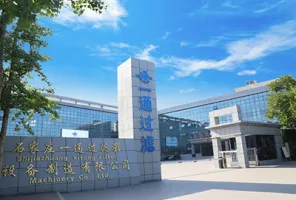
Shijiazhuang Yitong Filter Machinery Co., Ltd. is a China-based air filter manufacturer offering industrial filtration solutions, including gas turbine intake air filters, compact V-panel filters, HEPA filters, panel filters, bag filters, and customized air filtration products.
With more than 23 years of experience in the filtration industry, Yitong supports OEM and ODM projects and can develop filters according to customer requirements, drawings, dimensions, and application conditions.
If you are looking for a compact V-panel filter supplier for gas turbines, compressors, or turbomachinery, send us your filter dimensions, airflow requirements, equipment model, and application details.
Our technical team can help evaluate the required filter construction and provide a customized quotation.
Contact Shijiazhuang Yitong Filter Machinery Co., Ltd. for your OEM V-panel filter project.