September 21, 2026
When an HVAC or ventilation system needs reliable fine-particle filtration, choosing the right air filter is essential. F9 air filters are widely known in the European ventilation industry and are commonly used in air handling units, commercial buildings, industrial facilities, laboratories, pharmaceutical plants, and other applications requiring efficient fine filtration.
The F9 classification originated from the former EN 779 standard. Today, general ventilation filters are classified according to ISO 16890, which evaluates filter performance against different particulate-size fractions. Because the two standards use different classification methods, an F9 filter should not automatically be assigned one specific ISO 16890 equivalent without actual test data.
For buyers, distributors, HVAC contractors, and OEM customers, understanding the filter's actual performance is more important than looking at the F9 name alone.
In this guide, we explain what an F9 air filter is, how it works, where it is used, how to choose the right product, and what to consider when working with an F9 air filter manufacturer or supplier.
An F9 air filter is a fine air filter traditionally classified as F9 under the EN 779 standard.
Within the former EN 779 classification system, F9 was the highest class in the F7–F9 fine-filter range.
F9 filters are designed to remove a high proportion of fine airborne particles from ventilation and air-conditioning systems.
Typical applications include:
HVAC systems
Air handling units
Commercial buildings
Office buildings
Hospitals
Laboratories
Pharmaceutical facilities
Food processing plants
Electronics manufacturing
Industrial ventilation
Gas turbine air intake systems
F9 filtration can be supplied in several different configurations, including bag filters, pocket filters, compact filters, and V-bank filters.
The correct design depends on the required airflow, installation dimensions, pressure drop, operating environment, and filtration requirements.
One of the most common questions from HVAC buyers is:
What is the ISO 16890 equivalent of an F9 filter?
There is no universal one-to-one conversion.
The former EN 779 standard used classifications such as:
G4
M5
M6
F7
F8
F9
ISO 16890 uses a different approach and classifies filters according to particulate fractions such as:
ISO Coarse
ISO ePM10
ISO ePM2.5
ISO ePM1
Therefore, an F9 filter should be evaluated based on its actual test results rather than simply assuming that F9 equals one particular ISO 16890 classification.
For buyers replacing an existing F9 filter, it is important to request the manufacturer's test data and confirm:
Filtration efficiency
ISO 16890 classification
Airflow
Initial pressure drop
Recommended operating conditions
Filter dimensions
This is especially important for large commercial HVAC systems and industrial applications.
An F9 filter uses engineered filtration media to capture airborne particles as air passes through the filter.
Depending on the filter media and construction, particle capture can involve several mechanisms, including:
Interception
Inertial impaction
Diffusion
Electrostatic effects
The filtration media is normally designed with a large effective surface area.
For example, pocket filters use multiple filter pockets to increase the available filtration area. Compact filters use pleated media to achieve a large surface area in a relatively small installation space.
The result is a filter capable of providing fine-particle filtration while maintaining an appropriate balance between airflow and pressure drop.
Different HVAC systems require different filter constructions. An experienced F9 filter manufacturer can provide several configurations according to the application.
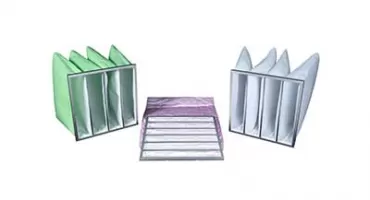
F9 Bag Filter
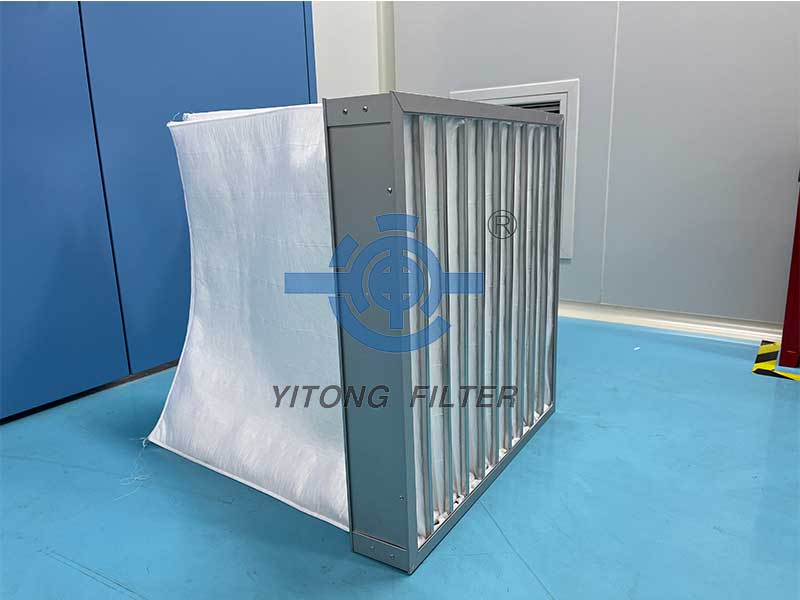
An F9 bag filter uses multiple flexible filter pockets to provide a large filtration surface.
The large media area makes bag filters suitable for many HVAC and air-handling applications.
Typical applications include:
Air handling units
HVAC systems
Commercial buildings
Industrial ventilation
Pharmaceutical facilities
Laboratories
F9 bag filters can be customized according to:
Filter dimensions
Pocket quantity
Pocket depth
Frame material
Filter media
Gasket configuration
2. F9 Compact Filter
An F9 compact filter is designed for applications where high filtration performance is required but installation space is limited.
The pleated media provides a large filtration area within a compact housing.
F9 compact filters are commonly used in:
AHUs
HVAC systems
Industrial ventilation
Commercial buildings
Clean air systems
For applications with limited installation space, a compact F9 filter can be an efficient alternative to deeper bag filters.
3. F9 Pocket Filter
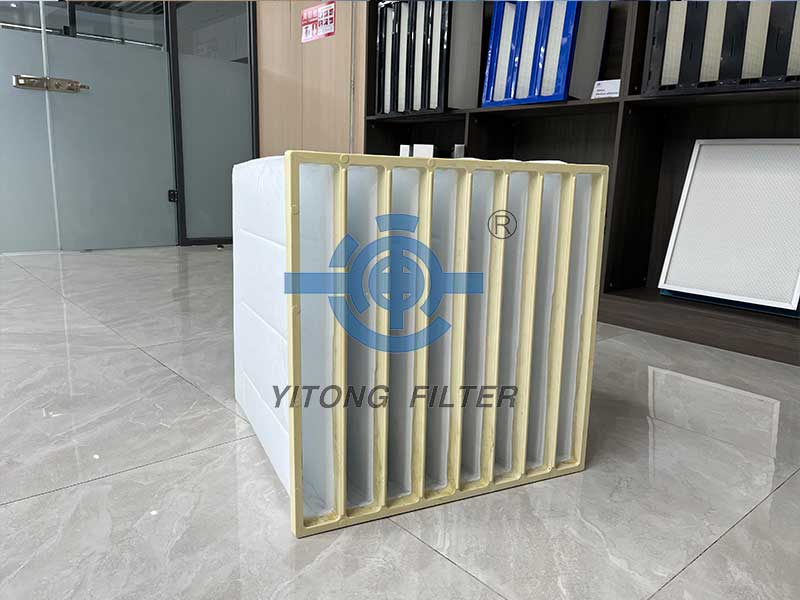
F9 pocket filters are designed with several filter pockets.
The pockets increase the effective filter area and can provide good airflow performance.
Depending on the required airflow and installation space, the manufacturer can adjust:
Number of pockets
Pocket depth
Filter height
Filter width
Media type
Frame construction
This makes the F9 pocket filter suitable for both standard replacement projects and customized OEM applications.
4. F9 V-Bank Filter
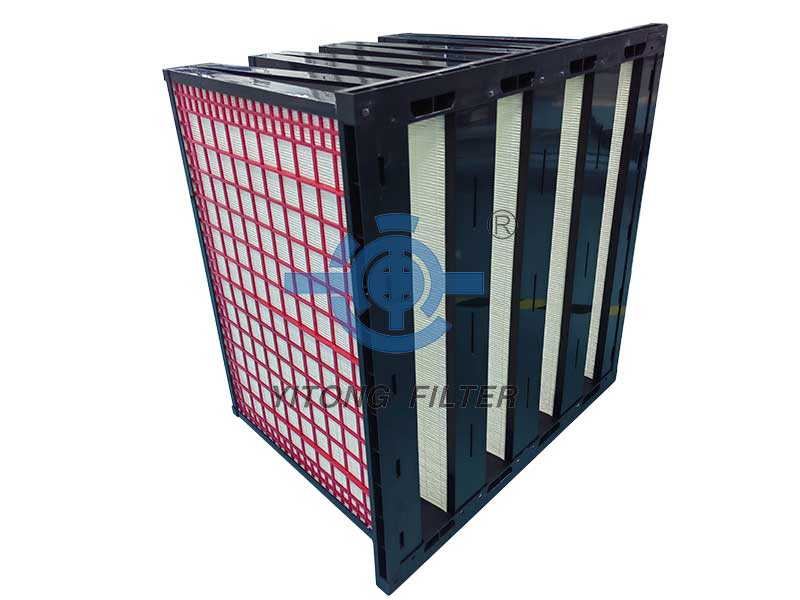
An F9 V-bank filter consists of multiple filter packs arranged in a V-shaped configuration.
This design provides a large filtration area within a relatively compact footprint.
V-bank filters can be used when an HVAC or industrial system requires:
High airflow
Fine filtration
Large filtration area
Compact installation
Long service intervals
For high-airflow applications, buyers should pay close attention to both filtration efficiency and pressure drop.
HVAC and Air Conditioning
F9 filters can be used in HVAC systems where fine-particle filtration is required.
They may be installed as part of a multi-stage filtration system, depending on the building and air-quality requirements.
Air Handling Units
Air handling units commonly use multiple stages of filtration.
For example, a system may use a coarse pre-filter followed by a finer filter.
The actual configuration should be selected according to:
Air quality requirements
Airflow
Equipment design
Energy requirements
Local regulations
Pharmaceutical Manufacturing
Pharmaceutical facilities require controlled air environments.
F9 filters can be used as part of a multi-stage filtration system before higher-efficiency filters.
However, an F9 filter should not be considered a replacement for a HEPA filter in applications where HEPA filtration is specifically required.
Hospitals and Healthcare Facilities
F9 filtration can be used in certain HVAC and ventilation applications in healthcare facilities.
The appropriate filtration level depends on the specific room, ventilation system, applicable standards, and contamination-control requirements.
Industrial Ventilation
Industrial facilities may have higher concentrations of airborne dust and particles.
An F9 filter can be used where fine-particle filtration is required and where its airflow and pressure-drop characteristics are suitable for the system.
Gas Turbine and Turbomachinery
Air filtration is an important part of gas turbine intake systems.
Depending on environmental conditions and equipment requirements, fine filters such as F9-rated products can be incorporated into multi-stage intake filtration systems.
For these applications, buyers should consider:
Airflow
Pressure drop
Dust-loading capacity
Humidity
Filter dimensions
Operating environment
Service life
F7 and F9 are both classifications from the former EN 779 system.
F9 represents a higher filtration class than F7 within that classification system.
However, higher filtration efficiency does not automatically mean that F9 is the correct choice for every HVAC system.
A filter must be selected according to the complete system requirements.
Important factors include:
| Factor | Why It Matters |
|---|---|
| Filtration efficiency | Determines particle removal performance |
| Airflow | Ensures sufficient ventilation |
| Pressure drop | Influences fan energy consumption |
| Filter size | Ensures correct installation |
| Media | Affects filtration and airflow |
| Dust loading | Influences service life |
| Frame | Provides structural support |
| Sealing | Helps minimize air bypass |
For this reason, an HVAC engineer or professional F9 filter supplier should evaluate the complete application before recommending a replacement filter.
Pressure drop is one of the most important specifications when purchasing an F9 air filter.
As air moves through the filter media, resistance is created. This resistance is measured as pressure drop, usually in Pa.
A filter's pressure drop changes during operation.
When the filter collects more particles, the resistance normally increases.
Therefore, buyers should look at:
Initial pressure drop
Operating airflow
Final pressure drop
Filter surface area
Dust-holding capacity
A good filter design should provide the required filtration performance while maintaining an appropriate pressure drop.
For large HVAC systems operating continuously, pressure drop can also have an important impact on energy consumption.
Choosing an F9 filter involves more than selecting the correct filter class.
1. Confirm the Dimensions
Always check the actual filter dimensions before ordering.
Important measurements include:
Length
Width
Depth
Frame dimensions
Installation direction
A professional F9 air filter manufacturer can produce customized dimensions for replacement and OEM projects.
2. Confirm the Airflow
The filter must be suitable for the system's actual airflow.
Airflow may be specified in:
m³/h
CFM
L/s
Do not select a filter only according to its physical dimensions.
3. Check Pressure Drop
Ask the supplier for pressure-drop data at the required airflow.
Comparing pressure drop at the same airflow provides a more meaningful comparison between different products.
4. Choose the Right Media
F9 filters can use different types of filtration media.
Depending on the manufacturer and application, options may include:
Synthetic fiber
Glass fiber
Composite media
Other engineered filter media
The choice should be based on filtration performance, airflow, operating environment, and required service life.
5. Select the Frame Material
Common frame materials include:
Galvanized steel
Aluminum
Plastic
For humid or corrosive environments, the frame material should be selected carefully.
6. Check the Gasket and Sealing
A good sealing system is essential.
Even high-performance filter media cannot deliver the expected system performance if air bypasses the filter through gaps around the frame.
Therefore, the gasket and filter housing should be compatible.
Regular maintenance helps keep HVAC systems operating efficiently.
The actual service life of an F9 filter depends on:
Air quality
Dust concentration
Operating hours
Airflow
Upstream filtration
Filter surface area
Environmental conditions
A good maintenance program should include:
1. Regular visual inspection
2. Pressure-drop monitoring
3. Checking the frame
4. Checking gasket condition
5. Checking for filter damage
6. Replacing heavily loaded filters
Rather than replacing every filter after exactly the same number of months, operators should consider actual operating conditions and manufacturer recommendations.
F9 filters and HEPA filters are different products.
An F9 filter belongs to the traditional fine-filter classification used in general ventilation.
HEPA filters are designed for much higher-efficiency particulate filtration and are used in applications such as:
Cleanrooms
Pharmaceutical production
Semiconductor manufacturing
Laboratories
Medical applications
Critical process areas
For example, Yitong supplies H13 and H14 HEPA filters for applications requiring high-efficiency filtration.
In some systems, an F9 filter can serve as an upstream filtration stage before a HEPA filter.
This can help protect the downstream HEPA filter from larger particle loading.
For commercial HVAC and industrial filtration projects, working directly with a professional manufacturer can provide several advantages.
A qualified manufacturer should be able to provide:
Product specifications
Filter dimensions
Airflow data
Pressure-drop data
Filtration test information
ISO 16890 classification where applicable
Filter media information
Frame options
Gasket options
OEM customization
For distributors and HVAC contractors, direct manufacturer support can also make it easier to develop customized replacement products.
Standard filters do not always fit every HVAC system.
For OEM projects, an F9 air filter manufacturer can customize the product according to the customer's requirements.
Possible customization includes:
Filter Size
Custom length, width, and depth.
Filter Media
Different synthetic or glass-fiber media options.
Frame
Galvanized steel, aluminum, plastic, or other suitable materials.
Pocket Design
Different pocket quantities and depths for bag or pocket filters.
Sealing
Different gasket materials and sealing configurations.
Packaging
Customized packaging, labels, cartons, and shipping marks.
Private Label
OEM branding and product identification for distributors and importers.
This makes customized F9 filters suitable for HVAC manufacturers, distributors, contractors, and industrial end users.
Shijiazhuang Yitong Filter Machinery Co., Ltd. is a China-based professional air filter manufacturer with more than 20 years of experience in the filtration industry.
Yitong provides filtration products for HVAC, cleanroom, industrial ventilation, gas turbine, pharmaceutical, food, medical, electronics, and other applications.
Our capabilities include:
Filter R&D
Filter design
Filter manufacturing
Product testing
OEM production
ODM services
Customized filter solutions
Our product range includes:
F9 air filters
F9 compact filters
F9 bag filters
F9 pocket filters
V-bank filters
HEPA filters
H13 HEPA filters
H14 HEPA filters
Mini-pleat filters
Panel filters
High-temperature HEPA filters
Gas turbine filters
Filter cartridges
For OEM customers, we can customize dimensions, media, frame materials, sealing systems, packaging, and product labeling according to project requirements.
If you are looking for an F9 air filter manufacturer in China, choosing the right supplier is important.
Before placing an order, we recommend confirming:
Product classification
Filter dimensions
Airflow
Initial pressure drop
Final pressure drop
Filter media
Frame material
Gasket type
Test data
Packaging
Lead time
OEM capability
For distributors and long-term buyers, it is also useful to work with a manufacturer that can provide consistent specifications across repeat orders.
At Shijiazhuang Yitong Filter Machinery Co., Ltd., we provide customized filtration solutions for customers in different markets and industries.
Whether you need F9 HVAC filters, F9 bag filters, F9 compact filters, or customized OEM filters, our technical team can help evaluate your requirements and develop a suitable solution.
Request an F9 Filter Quote
Looking for a reliable F9 filter supplier or F9 air filter manufacturer?
Send us your:
Filter size
Required airflow
Filter class
Frame material
Filter depth
Quantity
Application
Existing filter specifications or photos
Our team can review your requirements and provide a suitable OEM filtration solution.
Shijiazhuang Yitong Filter Machinery Co., Ltd.
Professional Air Filter Manufacturer | OEM & ODM Supported
1. What is an F9 air filter?
An F9 air filter is a fine air filter classification traditionally used under the EN 779 standard. F9 filters are commonly used in HVAC and ventilation systems requiring fine-particle filtration.
2. Is F9 the same as HEPA?
No. F9 and HEPA are different filtration classifications. HEPA filters are designed for significantly higher-efficiency particulate filtration and are used in more critical applications.
3. What is the ISO 16890 equivalent of F9?
There is no universal one-to-one conversion. The actual ISO 16890 classification should be determined from the filter's measured performance and test documentation.
4. Can I order a custom F9 filter?
Yes. F9 filters can be customized in terms of dimensions, media, frame, pocket configuration, gasket, packaging, and labeling.
5. Can F9 filters be used in AHUs?
Yes. F9 filters can be used in air handling units when their filtration performance, airflow, pressure drop, and dimensions are suitable for the system.
6. Can Yitong manufacture OEM F9 filters?
Yes. Yitong supports OEM and ODM filter manufacturing for distributors, HVAC companies, contractors, and industrial customers.
7. What information is needed for an F9 filter quotation?
The most useful information includes filter dimensions, airflow, filter type, quantity, frame material, application, and any existing filter model or specification.
8. How can I reduce F9 filter replacement costs?
Selecting an appropriate filter surface area, airflow, pressure drop, and dust-holding capacity can help optimize operating and replacement costs. A proper pre-filtration stage may also help protect finer downstream filters.
An F9 air filter can be an effective solution for fine-particle filtration in HVAC and industrial ventilation systems.
However, the F9 designation alone does not tell the complete story.
When selecting an F9 filter, look at the complete technical specification, including airflow, pressure drop, filter dimensions, media, filtration efficiency, frame, sealing, and actual test data.
For businesses purchasing filters regularly, working directly with an experienced F9 air filter manufacturer and OEM supplier can also make customized products, repeat orders, and quality control easier.
Need a customized F9 filter for your HVAC or industrial application? Contact Yitong for an OEM quotation and technical solution.