September 08, 2026
Clean air is essential in many modern industries. Pharmaceutical production, hospitals, laboratories, electronics manufacturing, food processing, and cleanrooms all require reliable air filtration to control airborne particles.
Among high-efficiency air filters, the H13 HEPA filter is one of the most widely used choices for applications where high levels of air cleanliness are required.
An H13 HEPA filter is classified according to EN 1822 and has an overall efficiency of at least 99.95% at the Most Penetrating Particle Size (MPPS). The standard also specifies a local efficiency requirement for H13 filters.
But what does H13 really mean? How does an H13 HEPA filter work? Where is it used? And what should you look for when choosing an H13 HEPA filter manufacturer or supplier?
This guide explains the key points in simple terms.
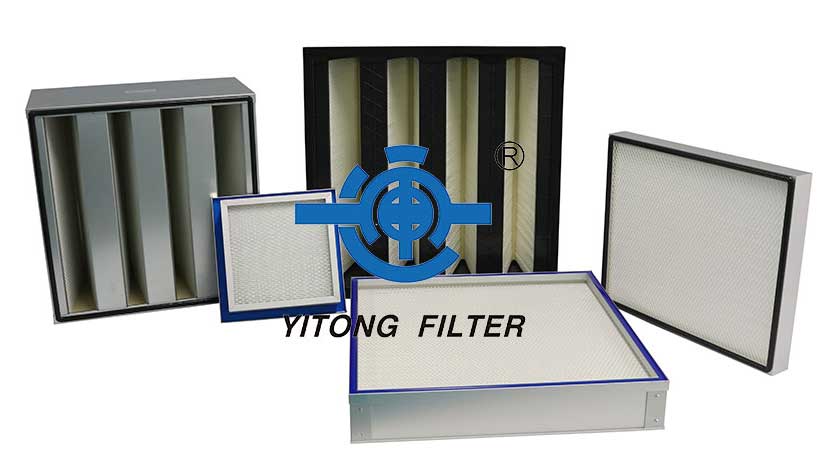
H13 HEPA filter is a high-efficiency particulate air filter classified under the HEPA group of the EN 1822 standard.
The H13 classification requires:
Overall efficiency: ≥ 99.95% at MPPS
Overall penetration: ≤ 0.05%
Local efficiency: ≥ 99.75%
Local penetration: ≤ 0.25%
These values are based on testing at the Most Penetrating Particle Size (MPPS) rather than simply testing one fixed particle size.
This is an important point when comparing HEPA filters.
A filter's performance cannot be judged only by a statement such as 99.97% efficiency. You should also check which testing standard was used, what particle size was tested, the airflow conditions, and whether the finished filter was individually tested.
An H13 HEPA filter usually contains a highly efficient filter media formed into closely spaced pleats.
The pleated structure provides a large filtration area while keeping the filter relatively compact.
Particles are captured through several mechanisms, including:
Particles traveling with the air stream come close to a filter fiber and are captured when they contact the fiber.
Larger particles have more inertia. When the airflow changes direction around filter fibers, these particles cannot follow the airflow perfectly and collide with the fibers.
Very small particles move in a random pattern known as Brownian motion. This increases their chances of contacting and being captured by the filter fibers.
Depending on the filter media and construction, electrostatic forces can also contribute to particle capture.
The combined effect of these mechanisms allows a properly designed H13 HEPA filter to achieve very high filtration efficiency.
One of the most common questions is:
Does 99.95% efficiency mean that the filter removes 99.95% of every particle?
Not exactly.
Under EN 1822, the H13 classification is based on performance at the MPPS, the particle size at which the filter has its lowest efficiency. The exact MPPS depends on the filter media and test conditions.
For H13:
99.95% efficiency = maximum overall penetration of 0.05% at MPPS.
This means that under the specified test conditions, no more than 0.05% of the challenge particles at the relevant MPPS penetrate the filter on an overall basis.
This makes H13 a demanding filtration class for applications that require controlled air cleanliness.
H13 and H14 are both HEPA classifications under EN 1822, but H14 provides a higher efficiency level.
| Filter Class | Overall Efficiency at MPPS | Overall Penetration |
|---|---|---|
| H13 | ≥ 99.95% | ≤ 0.05% |
| H14 | ≥ 99.995% | ≤ 0.005% |
H14 therefore allows a significantly lower level of particle penetration than H13.
However, higher efficiency does not automatically mean H14 is the best choice for every application.
The correct filter depends on the required cleanliness level, airflow, pressure drop, equipment design, energy consumption, installation requirements, and applicable regulations.
For many applications, a well-designed H13 HEPA filter provides an excellent balance between filtration performance and airflow resistance.
HEPA and ULPA filters are both high-efficiency filters, but ULPA filters are designed for even higher particle removal performance.
Under EN 1822:
H13: ≥ 99.95%
H14: ≥ 99.995%
U15: ≥ 99.9995%
U16: ≥ 99.99995%
U17: ≥ 99.999995%
For most general high-efficiency air filtration applications, H13 or H14 may be sufficient. More demanding applications can require ULPA filtration.
The important point is to select the filter according to the actual process requirements instead of simply choosing the highest available efficiency.
H13 HEPA filters are used in many environments where high-quality air filtration is required.
Cleanrooms require controlled airborne particle concentrations.
H13 HEPA filters can be used in:
Pharmaceutical cleanrooms
Medical device manufacturing
Electronics production
Semiconductor facilities
Laboratory environments
Food processing areas
Precision manufacturing
HEPA filtration is an important component of many clean air systems and cleanroom air-handling designs.
Pharmaceutical production requires strict control of airborne contamination.
H13 HEPA filters can be incorporated into:
AHU systems
Cleanroom air supply systems
Fan filter units
Laminar airflow systems
Air purification equipment
Clean production areas
Filter performance, sealing, installation quality, and testing are all important because a high-efficiency filter cannot perform correctly if air bypasses the filter through gaps or damaged seals.
High-efficiency filtration can be used in selected healthcare environments where airborne particle control is important.
Applications can include:
Operating rooms
Isolation areas
Special treatment rooms
Laboratory areas
Medical equipment
HVAC systems requiring HEPA filtration
The required filter grade should always be determined by the specific application and applicable healthcare standards.
Laminar airflow equipment is designed to provide highly filtered air over a controlled working area.
H13 HEPA filters can be used in:
Laminar flow cabinets
Clean benches
Laboratory equipment
Pharmaceutical workstations
Controlled production areas
For these applications, filter dimensions, gasket type, airflow direction, face velocity, pressure drop, and sealing method should all be considered.
H13 HEPA filters can also be installed in advanced HVAC and air-handling systems.
A typical system may use several filtration stages:
Pre-filter → Fine filter → H13 HEPA filter
The pre-filters remove larger particles before air reaches the HEPA filter. This can help reduce the particle load on the final filter.
Using appropriate pre-filtration is especially important for industrial applications where the incoming air contains significant dust.
The exact construction varies by application, but an H13 HEPA filter commonly consists of several key components.
High-efficiency filter media is responsible for particle capture.
Common materials include:
Microglass fiber
Synthetic media
PTFE membrane
Other specialized high-efficiency media
The media selected should match the required efficiency, airflow, temperature, chemical environment, and application.
The frame provides structural support.
Common frame materials include:
Aluminum
Galvanized steel
Stainless steel
Other application-specific materials
Aluminum frames are particularly popular for many cleanroom and HVAC applications because they offer a good combination of strength, corrosion resistance, and relatively low weight.
Traditional separator HEPA filters use separators to maintain spacing between pleats.
Modern mini-pleat HEPA filters use adhesive bead technology instead of traditional separators, allowing manufacturers to create a large filtration area in a compact package.
The sealing system is critical.
Even if the filter media itself has excellent efficiency, contaminated air can bypass the media if the filter does not seal properly against the housing.
Common sealing configurations include:
Gasket seal
Gel seal
Knife-edge seal
The correct option depends on the equipment and installation design.
High filtration efficiency is important, but it is not the only performance factor.
Pressure drop is also critical.
As air passes through a filter, resistance is created. A filter with excessive pressure drop can increase the workload of the fan and potentially increase energy consumption.
For this reason, filter selection should consider:
Airflow rate
Filter dimensions
Filtration area
Filter media
Initial pressure drop
Final pressure drop
Fan capacity
Operating conditions
A larger filter area can often provide the required airflow at a lower face velocity and may help manage pressure drop.
This is why simply choosing a small H13 filter because it is cheaper may not be the best long-term solution.
If you are purchasing an H13 HEPA filter, consider the following factors.
Confirm that the filter meets the required H13 classification under the relevant testing standard.
Do not rely only on marketing terms such as high efficiency or HEPA quality.
Ask for test documentation.
The filter must match the equipment and housing.
Provide the manufacturer with:
Length
Width
Depth
Frame dimensions
Gasket position
Airflow direction
For OEM applications, custom dimensions are often available.
Specify the required airflow before selecting the filter.
For example:
Required airflow: 1,000 m³/h
The manufacturer can then recommend an appropriate filter size and configuration based on the required operating conditions.
Ask the supplier for pressure-drop data at the required airflow.
A good H13 HEPA filter supplier should be able to provide technical information rather than only a product price.
Choose the frame according to the environment.
For example:
Aluminum — lightweight and corrosion resistant
Galvanized steel — economical and strong
Stainless steel — suitable for demanding environments
The sealing method should match the filter housing.
Possible options include:
PU gasket
EPDM gasket
Gel seal
Knife-edge seal
The correct sealing solution helps minimize air leakage around the filter.
Standard HEPA filters are not suitable for every temperature range.
If the application involves high-temperature air, chemical exposure, humidity, or other challenging conditions, tell the manufacturer before ordering.
Special high-temperature HEPA filters may be required.
For critical applications, the finished filter should be tested rather than relying only on the efficiency of the raw filter media.
EN 1822 classification involves testing the finished filter and evaluating its performance at the relevant particle size. H13 and H14 filters also have local penetration requirements.
Depending on the application, customers may request documentation such as:
EN 1822 test report
Scan leak test report
Efficiency test results
Pressure-drop data
Airflow performance data
Material specifications
When purchasing filters for pharmaceutical, medical, semiconductor, or other critical applications, documentation can be just as important as the filter itself.
A HEPA filter is not designed to be cleaned like a washable metal filter.
When the filter becomes loaded with particles, its pressure drop increases. The filter should be replaced according to the equipment manufacturer's maintenance requirements and actual operating conditions.
A good maintenance program should monitor:
Differential pressure
Airflow
Filter condition
Sealing condition
Installation condition
Replacement intervals
The actual replacement interval depends heavily on the environment and pre-filtration system.
Industrial environments can have very different filtration requirements from commercial buildings.
For example, manufacturing facilities may deal with:
Dust
Fine particles
Oil mist
Chemical contaminants
Process-generated particles
High airflow volumes
In these situations, an industrial H13 HEPA filter should be selected according to the complete operating environment.
A reliable system may combine multiple filtration stages to protect the H13 final filter and maintain stable airflow.
Choosing an experienced manufacturer can make the procurement process much easier.
A professional H13 HEPA filter manufacturer should be able to support you with:
Standard and custom sizes
Different frame materials
Multiple sealing options
Different filter depths
OEM/ODM production
Technical documentation
Performance testing
Packaging for international shipping
For large-volume projects, custom filter design can also help optimize airflow, pressure drop, installation, and overall operating costs.
If you are an HVAC company, cleanroom contractor, equipment manufacturer, distributor, or industrial buyer, standard filters may not always fit your requirements.
An experienced OEM H13 HEPA filter supplier can manufacture filters according to your specifications.
Typical OEM requirements may include:
Custom dimensions
Custom frame
Filter depth
Media selection
Gasket configuration
Airflow direction
Pressure-drop requirements
Packaging requirements
Private labeling
Before requesting a quotation, it is helpful to provide the supplier with the filter drawing, dimensions, required airflow, efficiency class, operating temperature, and application.
This allows the manufacturer to recommend a suitable configuration and provide a more accurate quotation.
Before placing an order, check the following:
☑ H13 classification required
☑ EN 1822 test documentation
☑ Correct filter dimensions
☑ Correct airflow
☑ Acceptable pressure drop
☑ Suitable frame material
☑ Correct gasket or sealing method
☑ Suitable operating temperature
☑ Suitable filter media
☑ Individual filter testing if required
☑ Proper packaging for transportation
☑ OEM/custom manufacturing capability
A good purchasing decision should consider performance, quality, service life, and total operating cost, not only the initial unit price.
An H13 HEPA filter is a high-efficiency air filter designed for applications where effective control of airborne particles is important.
With an EN 1822 overall efficiency of at least 99.95% at MPPS, H13 provides a strong combination of filtration performance and practical usability.
However, choosing the right HEPA filter involves more than selecting an efficiency rating. Filter size, airflow, pressure drop, media, frame, sealing method, operating environment, testing, and installation all affect real-world performance.
If you are looking for an H13 HEPA filter manufacturer or OEM supplier, work with a company that can provide both customized products and reliable technical documentation.
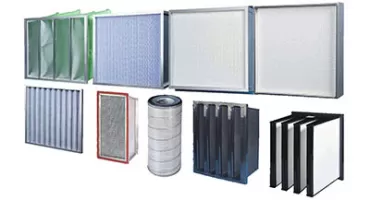
Shijiazhuang Yitong Filter Machinery Co., Ltd. provides air filtration products for industrial and clean-air applications, including HEPA filters, H13/H14 filters, mini-pleat filters, V-bank filters, and customized OEM filtration solutions.
Need a custom H13 HEPA filter? Send us your size, airflow, frame material, sealing requirements, and application. Our technical team can help you select the right configuration for your project.