October 28, 2026
Industrial air filters play an important role in maintaining air quality, protecting equipment, and supporting reliable production processes. They are used in HVAC systems, manufacturing facilities, cleanrooms, commercial buildings, and other environments where airborne particles or contaminants need to be controlled.
However, not all industrial air filters perform the same function. Some filters capture larger particles such as dust and fibers, while others are designed to remove fine airborne particles or reduce certain gaseous contaminants. Choosing the right filter depends on the required air quality, airflow rate, operating environment, filtration efficiency, and acceptable pressure drop.
This guide explains the main types of industrial air filters, their applications, the differences between filtration efficiency ratings, and the key factors to consider when selecting a filter for your system.
Whether you are replacing an existing filter or planning a new air filtration system, understanding these factors can help you make a more informed purchasing decision.
Industrial air filters are filtration components designed to remove unwanted airborne particles or specific contaminants from an air stream. Depending on their design and filter media, they can capture dust, pollen, fibers, fine particulate matter, and other suspended particles. Specialized filters containing suitable adsorbent media can also reduce certain gaseous pollutants and odors.
Industrial air filters are commonly installed in air handling units, ventilation systems, production equipment, cleanroom air supply systems, and industrial dust collection equipment.
Their primary purposes include:
Improving air cleanliness: Removing airborne particles to help meet the requirements of a particular indoor or industrial environment.
Protecting equipment: Reducing the accumulation of dust and other particles on sensitive components.
Supporting production quality: Helping control airborne contamination in processes where product cleanliness matters.
Protecting downstream filters: Using pre-filtration to capture larger particles before air reaches higher-efficiency filters.
Supporting system performance: Selecting suitable filters to balance filtration efficiency, airflow, and pressure drop.
The appropriate filter depends on the contaminants present and the performance requirements of the application. A filter designed for ordinary ventilation, for example, may not provide the level of particle control required in a pharmaceutical cleanroom.
Industrial air filters are available in several designs, each suited to different operating conditions and filtration requirements. The following comparison can help identify which filter type may be appropriate for your application.
| Filter Type | Main Function | Common Applications | Key Consideration |
|---|---|---|---|
| Panel and pleated filters | Capture larger airborne particles and provide general ventilation filtration | HVAC systems, commercial buildings, industrial ventilation | Initial and final pressure drop, dust-holding capacity |
| Bag filters | Provide medium or fine particle filtration, depending on the media and grade | Air handling units, factories, commercial ventilation | Pocket design, airflow distribution, filter efficiency |
| HEPA filters | Capture very fine airborne particles at high efficiency | Cleanrooms, laboratories, pharmaceutical production | Certified efficiency, leakage testing, proper installation |
| Activated carbon filters | Adsorb selected gases, odors, and volatile compounds | Odor control, certain chemical environments, specialized ventilation | Carbon type, media quantity, contaminant compatibility |
| Cartridge filters | Capture dust from industrial process air and dust collection systems | Metalworking, woodworking, powder handling, manufacturing | Dust properties, cleaning method, pressure drop |
The filter type alone does not determine performance. Actual efficiency, dimensions, media composition, airflow capacity, and test results should be checked against the requirements of the application.
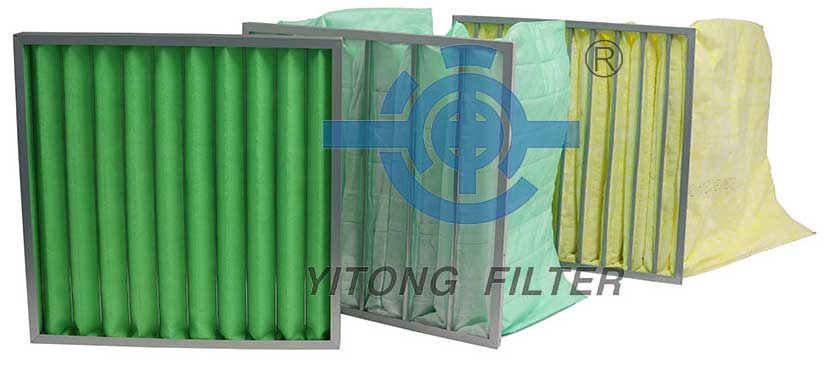
Panel and pleated air filters are widely used as pre-filters or general ventilation filters. Their media is arranged in a flat or pleated configuration to provide a filtration surface within a relatively compact frame.
These filters can capture larger airborne particles and help reduce the particle load reaching downstream filters. Pleated designs may provide more media area than a flat design of comparable face dimensions, depending on the construction.
Typical applications include:
Commercial and industrial HVAC systems
Air handling units
Factory ventilation systems
Pre-filtration stages in multistage filtration systems
What to consider: Check the filter dimensions, airflow requirements, efficiency classification, pressure drop, frame material, and replacement frequency. A pre-filter should be selected as part of the complete filtration system rather than in isolation.
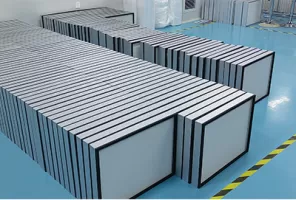
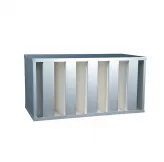
Bag filters, also called pocket filters, contain multiple pockets of filter media that expand when air flows through them. This construction provides a relatively large media area and can support medium or fine filtration, depending on the filter design and classification.
Bag filters are commonly installed downstream of pre-filters in HVAC systems and industrial ventilation applications.
Typical applications include:
Industrial air handling units
Commercial ventilation systems
Factory air supply systems
Pre-filtration before higher-efficiency final filters
What to consider: Compare the filtration efficiency, pocket length and number, media type, airflow capacity, pressure drop, and frame dimensions. Ensure that the filter fits securely into the housing and that air cannot bypass the media around the edges.
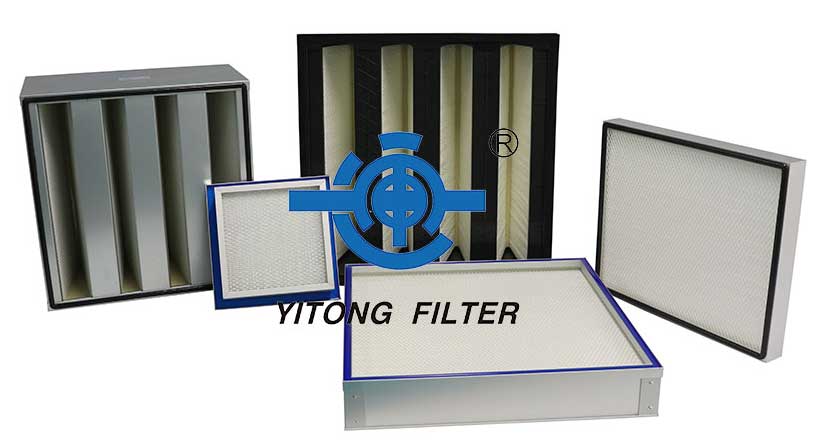
High-Efficiency Particulate Air (HEPA) filters are designed for high-efficiency removal of airborne particles. They are used where stringent particle-control requirements apply, including certain cleanrooms, laboratories, pharmaceutical production areas, and specialized industrial environments.
HEPA filters are often installed as final filtration stages. Depending on the application, they may be used with pre-filters and intermediate filters to help manage particle loading and maintain system performance.
Typical applications include:
Cleanroom air supply systems
Pharmaceutical and biotechnology facilities
Laboratories and research environments
Sensitive manufacturing processes
Other applications requiring high-efficiency particulate filtration
What to consider: Confirm the required efficiency classification and applicable test standard. Also evaluate airflow, pressure drop, filter dimensions, sealing arrangements, and whether individual filter integrity or leakage testing is required.
A HEPA filter's performance depends on more than its nominal efficiency. Proper installation and sealing are essential to prevent unfiltered air from bypassing the filter.
Activated carbon filters use adsorbent media to reduce selected gaseous contaminants and odors. They are different from particulate filters because their main purpose is gas-phase treatment rather than the removal of airborne particles alone.
Their performance depends on the type and quantity of carbon or other adsorbent media, the chemical properties of the contaminant, humidity, temperature, airflow, and contact time.
Typical applications include:
Odor control in ventilation systems
Certain industrial exhaust and air-treatment applications
Selected chemical and process environments
Facilities requiring reduction of specific gaseous contaminants
What to consider: Identify the target contaminant before choosing the filter. Activated carbon does not remove every gas equally well, and it should not be assumed to provide protection against an unspecified chemical exposure. For demanding applications, consult a qualified filtration specialist and confirm media compatibility and performance data.
Cartridge filters are commonly used in industrial dust collection systems. Their cylindrical or compact pleated construction provides a substantial filtration surface within a limited space.
Depending on the media and design, cartridge filters can capture dust generated by manufacturing processes and may be used with pulse-jet or other cleaning systems.
Typical applications include:
Metalworking and fabrication
Woodworking and furniture manufacturing
Powder processing
Industrial production and material handling
Selected dry dust collection applications
What to consider: Evaluate the dust particle characteristics, dust loading, moisture content, operating temperature, filter media, cleaning method, and required airflow. Combustible, explosive, sticky, or hazardous dust may require specialized equipment and a formal risk assessment.
Cartridge filters used in dust collectors are not automatically interchangeable with panel, bag, or HEPA filters used in ventilation systems. Selection must reflect the equipment design and operating conditions.
Selecting an industrial air filter requires more than choosing a filter by name or nominal efficiency. A suitable filter must meet the air-quality objective while remaining compatible with the system's airflow, operating environment, and maintenance requirements.
Use the following steps when evaluating industrial air filtration options.
Start by identifying what needs to be removed from the air.
Common examples include:
Coarse dust and fibers
Fine airborne particles
Process-generated dust
Selected gases and odors
Mixed particulate and gaseous contaminants
The contaminant determines the appropriate filtration mechanism. Particulate filters capture airborne particles, while activated carbon and other suitable adsorbents are used for certain gaseous contaminants.
If the air contains both particles and gases, a multistage system may be necessary.
The required efficiency depends on the application and the cleanliness level that must be achieved.
A general ventilation system may use a different filter classification from a cleanroom or a process requiring high-efficiency particulate removal.
When comparing filter specifications, confirm which standard and classification system are being used. Common references include:
ISO 16890: Used to classify general ventilation air filters based on their particulate removal performance.
EN 1822: Used for the classification and testing of high-efficiency air filters, including HEPA and ULPA filters.
ISO 29463: An international series of standards covering high-efficiency filters and filter media.
These standards are not interchangeable. For example, a general ventilation efficiency rating should not be directly treated as equivalent to a HEPA classification.
If a specification uses terms such as G4, F7, F9, H13, or H14, verify the applicable standard and the edition under which the filter was classified. G4, F7, and F9 are classifications associated with the former EN 779 system, while H13 and H14 are high-efficiency filter classes associated with EN 1822. Do not assume that classifications from different standards are directly equivalent.
Airflow is a key factor in filter selection. The filter must accommodate the required volume of air without creating an unacceptable restriction in the system.
Before ordering, confirm:
Required airflow rate
Filter face dimensions and available installation space
Operating conditions of the air handling equipment
Permissible pressure drop
Whether the system operates continuously or intermittently
A filter selected without reference to system airflow may not provide the expected performance. Always check the manufacturer's rated operating conditions and ensure compatibility with the equipment.
Pressure drop is the resistance a filter creates as air passes through it. It generally increases as a filter accumulates particles, although the rate of change depends on the media, contaminant loading, and operating conditions.
A filter with a lower initial pressure drop may help reduce fan energy consumption, but initial pressure drop alone is not enough to determine the best option.
Compare:
Initial pressure drop at the specified airflow
Recommended final or terminal pressure drop
Dust-holding capacity where relevant
Expected operating conditions and replacement intervals
Compatibility with the fan and ventilation system
The objective is to balance filtration performance, service life, and total operating cost rather than selecting a filter based on one specification alone.
Industrial conditions can vary considerably between applications. Temperature, humidity, chemicals, and moisture can affect filter media, frames, adhesives, seals, and overall performance.
Confirm the following before purchasing:
Normal and maximum operating temperature
Relative humidity and possible condensation
Presence of corrosive chemicals or vapors
Exposure to water, oil mist, or sticky contaminants
Mechanical vibration or other special operating conditions
Any applicable fire, safety, or process requirements
If the filter will operate in a demanding environment, request technical documentation confirming its suitability. Do not assume that a filter suitable for ordinary HVAC use is appropriate for every industrial process.
Even a high-efficiency filter may fail to deliver the intended system performance if it is incorrectly sized or poorly sealed.
Check the exact length, width, depth, frame construction, gasket arrangement, and installation direction where applicable. Confirm that the filter is compatible with the existing housing and that the installation method minimizes air bypass.
For high-efficiency applications, additional integrity or leakage testing may be required according to the system specification.
The lowest purchase price does not necessarily mean the lowest operating cost.
A practical comparison should consider:
Purchase price
Expected replacement frequency
Pressure drop over the service life
Labor and maintenance requirements
Disposal requirements
Availability of replacement filters
For industrial facilities with multiple filtration stages, an appropriately selected pre-filter may help protect more expensive downstream filters. The actual benefit depends on the system design, contaminant loading, and maintenance practices.
Different industries have different air-quality objectives. Understanding the application helps narrow down the appropriate filter type and performance requirements.
Manufacturing plants may need to control dust, fibers, and other airborne particles generated by production activities. Panel filters, bag filters, cartridge filters, and other specialized filters may be used depending on whether the objective is ventilation filtration, equipment protection, or process dust collection.
Filter selection should be based on the type of contaminant, production process, airflow, and operating environment.
Industrial and commercial HVAC systems use air filters to reduce airborne particles in supplied or recirculated air. A multistage arrangement may combine pre-filters, intermediate filters, and final filters to meet the system's air-quality requirements.
The appropriate combination depends on the required cleanliness, available space, airflow, and acceptable pressure drop.
Pharmaceutical production, laboratory work, and cleanroom operations may require tightly controlled airborne particle levels.
High-efficiency filters are commonly used where the system design and cleanliness requirements call for them. The correct classification, installation method, sealing, and integrity testing should be determined by the relevant project specification and applicable standards.
Food and beverage facilities may use air filtration to help control airborne particles in production and packaging environments. The necessary filtration level depends on the process, the risk of contamination, and the facility's hygiene requirements.
Filter materials and construction should be suitable for the installation environment and any applicable regulatory or operational requirements.
Some chemical and industrial environments require treatment of gaseous contaminants or odors in addition to particulate filtration.
Activated carbon or other specialized adsorbents may be suitable when selected for the specific contaminants involved. Because adsorption performance varies by substance and operating conditions, technical assessment is important before specifying a filter.
Regular inspection and timely replacement help maintain the intended performance of an industrial air filtration system.
A maintenance program should be based on the filter manufacturer's recommendations, the operating environment, and measured system conditions.
Where practical, monitor the pressure drop across the filter. An increase may indicate particle loading or another change in system conditions. Follow the specified terminal pressure drop or replacement criteria rather than relying only on a fixed calendar interval.
Check for damaged media, deformed frames, loose seals, visible contamination, and evidence of air bypass. Filters used in critical applications may require more formal inspection and testing procedures.
Use a replacement filter with compatible dimensions and the required performance classification. Follow the equipment manufacturer's installation instructions and make sure the filter is seated and sealed correctly.
Do not clean or reuse a disposable filter unless the manufacturer explicitly permits the relevant procedure.
Record filter installation dates, pressure-drop readings, replacement dates, and any unusual operating conditions. These records can help identify maintenance trends and support better purchasing decisions.
A well-planned maintenance program can improve system reliability and reduce the risk of unexpected filtration problems.
Providing accurate technical information helps suppliers recommend a suitable product and reduces the risk of ordering an incompatible filter.
Before requesting a quotation, prepare as much of the following information as possible:
Filter type: Panel, bag, HEPA, activated carbon, cartridge, or another design.
Dimensions: Length, width, depth, frame dimensions, and any special mounting requirements.
Filtration requirement: Required efficiency class and the applicable test standard.
Airflow: Required airflow rate and relevant operating conditions.
Pressure drop: Acceptable initial and final pressure drop, if specified.
Operating environment: Temperature, humidity, chemicals, moisture, or other special conditions.
Filter media and frame: Required materials, if already specified.
Quantity: Estimated order quantity and expected purchasing frequency.
Application: HVAC, cleanroom, process ventilation, dust collection, or another use.
Documentation: Any required test reports, certifications, drawings, or inspection records.
If you do not know all these details, provide the available information and explain the application. A qualified supplier may be able to help identify which specifications still need to be confirmed.
The right industrial air filter should match the actual requirements of the system rather than relying on a generic description such as “high efficiency” or “industrial grade.”
A well-defined specification helps buyers compare products more accurately, assess operating costs, and confirm whether a filter is appropriate for its intended application.
When evaluating a supplier, consider the following:
Availability of clear technical specifications
Compatibility with your required dimensions and installation method
Documentation of filtration efficiency and applicable test standards
Ability to discuss airflow and pressure-drop requirements
Communication about customization, lead times, and order quantities
Availability of replacement products and technical support
For customized or critical applications, request product drawings and relevant test documentation before confirming an order.
Industrial air filter is a broad term that covers many types of filtration products. A HEPA filter is a specific type of high-efficiency particulate filter designed and classified under an applicable standard. Not every industrial air filter is a HEPA filter, and the appropriate type depends on the application's air-quality requirements.
The best option depends on the dust characteristics and the equipment in which the filter will be installed. Panel or bag filters may be used for ventilation filtration, while cartridge filters are commonly used in industrial dust collection systems. Fine or hazardous dust may require a more specialized solution and an assessment of the applicable safety requirements.
Start with the required air cleanliness and the type of contaminant. Then confirm the applicable efficiency classification, test standard, airflow, pressure drop, and installation requirements. Do not compare ratings from different classification systems as if they were automatically equivalent.
There is no single replacement interval suitable for every industrial air filter. Replacement depends on particle loading, operating hours, environmental conditions, filter design, and the manufacturer's specified limits. Pressure-drop monitoring and regular inspections can help establish an appropriate maintenance schedule.
Some industrial air filters can be supplied in different dimensions, frame materials, media configurations, or other specified designs. Availability depends on the product and manufacturer. Buyers should provide the required dimensions, performance specifications, operating conditions, and quantity to determine whether a suitable customized option is available.
The most useful information includes the filter type, dimensions, required efficiency, airflow, operating environment, quantity, and intended application. If an existing filter is being replaced, its label, technical datasheet, drawing, or clear photographs may help the supplier identify the required specifications.
Selecting an industrial air filter involves balancing filtration efficiency, airflow, pressure drop, operating conditions, and maintenance requirements. A clear understanding of these factors can help you identify a suitable solution for your ventilation system, manufacturing facility, or specialized filtration application.
Yitong Filter Machinery Co., Ltd. provides industrial filtration products for different application requirements. If you are looking for an industrial air filter or need help identifying the appropriate product specifications, contact our team to discuss your project.
When making an inquiry, please include the required dimensions, filtration grade, airflow, application, and estimated quantity whenever possible. This information can help clarify your requirements and support a more accurate product recommendation.
Contact Yitong to discuss your industrial air filtration requirements and request a quotation.