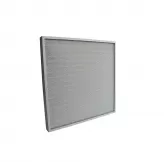
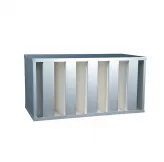
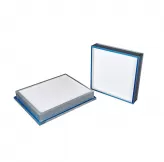
Type: Mini-pleat
Frame material:Aluminum frame
Filter class: H14
Filter media: Micro glass fiber
Size: 610*1220*70mm
Lower pressure drop
Protective mesh on both sides
Perfect edges of pleated filter media
Sealant: polyurethane glue
Yitong Filter's H14 HEPA filter is a high-efficiency air filtration solution designed for applications that require stringent airborne particle control. Featuring a mini-pleat structure, micro glass fiber filter media, an aluminum frame option and protective mesh on both sides, this filter can be configured to meet different airflow, installation and filtration requirements.
Under the EN 1822 classification system, an H14 filter has a minimum overall filtration efficiency of 99.995% at the most penetrating particle size (MPPS), when tested and classified in accordance with the applicable standard.
Yitong Filter offers different filter media, frame materials, dimensions and sealing options to support project-specific requirements. Contact our team to confirm the suitable configuration, operating conditions and testing documentation for your application.

Key Product Features
Filter class: H14
Construction: Mini-pleat
Filter media: Micro glass fiber; other media options subject to confirmation
Frame: Aluminum alloy or other available configurations
Protective mesh: Both sides
Sealant: Two-component polyurethane adhesive
Custom dimensions and configurations available upon technical confirmation
Need a filter for your system? Send us your required dimensions, airflow, operating conditions and filtration specifications to request a quotation.
| Product Specification | ||||||||
| Model | Size (mm)(W×H×D) | Rated airflow (m³/h) | Face velocity (m/s) | Cleanpressure drop (Pa) | Final pressure drop (Pa) | |||
| YTGXW | H10 | H11 | H13 | H14 | ||||
| 305×610×50 | 800 | 1.2 | 120 | 180 | 250 | 270 | 2-2.5 times of clean pressure drop | |
| 610×610×50 | 1600 | 1.2 | 120 | 180 | 250 | 270 | ||
| 610×610×70 | 1600 | 1.2 | 85 | 145 | 220 | 240 | ||
| 1170×570×70 | 2800 | 1.2 | 85 | 145 | 220 | 240 | ||
| 610×610×80 | 1600 | 1.2 | 75 | 135 | 215 | 230 | ||
| 610×915×80 | 2400 | 1.2 | 75 | 135 | 215 | 230 | ||
| Parameter | Specification |
|---|---|
| Product Type | Mini-Pleat HEPA Filter |
| Filter Class | H14 |
| Classification Standard | EN 1822, subject to the applicable product test and classification documentation |
| Filter Media | Micro Glass Fiber |
| Alternative Filter Media | PTFE or PP, subject to model availability and performance verification |
| Frame Material | Aluminum Alloy; other frame materials available upon confirmation |
| Sealant | Two-Component Polyurethane Adhesive |
| Gasket Options | EPDM, EVA or PU Foam, subject to configuration |
| Separator | Hot-Melt Adhesive |
| Protective Mesh | Both Sides |
| Reference Size | 610 × 1220 × 70 mm |
| Optional Thickness | 22–120 mm, subject to model availability |
| Maximum Operating Temperature | 70°C, as specified for the applicable product configuration |
| Maximum Relative Humidity | Confirm with the manufacturer for the selected media, sealant and operating conditions |
| Rated Airflow | To be confirmed for the selected dimensions and model |
| Initial Pressure Drop | To be confirmed at the specified rated airflow |
| Final Recommended Pressure Drop | To be established according to the filter model and HVAC system requirements |
| Leak Test / Scan Test | Available test method and documentation to be confirmed for the supplied model |
Important: Filter efficiency, airflow and pressure drop depend on the filter configuration and test conditions. Please request the technical datasheet and applicable test report for the exact model before placing an order.
H14 is a HEPA filter classification under EN 1822. Its minimum overall efficiency is 99.995% at the most penetrating particle size (MPPS). Actual product performance should be verified using the test report for the supplied filter.
The mini-pleat design arranges filter media into closely spaced pleats. Depending on the filter dimensions and design, this construction can provide a practical balance between filtration efficiency, airflow and pressure drop.
Micro glass fiber is the specified media for the reference product. PTFE and polypropylene media may also be available for selected configurations. Media selection should be based on required filtration performance, operating conditions and compatibility with the application.
Protective mesh helps protect the pleated media during handling, installation and normal operation. Mesh specifications should be selected to suit the filter design and airflow requirements.
The reference configuration uses an aluminum frame and polyurethane adhesive. Other frame and gasket options may be available depending on the model. Proper sealing and dimensional compatibility are essential to minimize air bypass around the filter.
Ask for the applicable efficiency classification, scan or leak-test documentation, airflow conditions and pressure-drop data for the exact filter model. Testing claims should be supported by records that identify the supplied product and the relevant test method.
H14 HEPA filters are used in air handling and terminal filtration systems where a high level of airborne particle control is required. The appropriate filter configuration depends on the cleanliness target, airflow, installation design and applicable industry requirements.
H14 filters may be specified for critical cleanroom zones, pharmaceutical production areas and other controlled environments where high-efficiency particulate filtration is required. Final selection should follow the facility's cleanroom design and validation requirements.
High-efficiency filters can support particle control in electronics production and other contamination-sensitive manufacturing environments. Filter selection should consider the required cleanliness level, airflow uniformity and compatibility with the air handling system.
H14 filters may be used in selected healthcare ventilation or terminal filtration applications where the system design requires this filtration class. The required grade and installation arrangement must be determined by the facility's engineering and infection-control requirements.
Laboratories may use H14 filtration in applications requiring high-efficiency particle removal. Filtration alone does not replace the ventilation, containment, pressure-control or exhaust requirements of a laboratory.
Depending on the system design, H14 filters may be suitable for other controlled environments requiring high-efficiency particle filtration. Confirm the required filter class, rated airflow, pressure drop and sealing arrangement before selection.
EN 1822: This European Standard specifies the performance requirements for HEPA filters used in various applications. Compliance with this standard ensures that filters meet stringent air purification requirements.
ISO 29463: Internationally, the ISO 29463 standard is harmonized with EN 1822 and specifies the efficiency and testing methods for HEPA and ULPA filters.
When selecting an H14 HEPA filter, it's important to ensure it meets the required standards and is suitable for the intended application, considering both the necessary air quality and the system's air flow requirements.


The main difference between H13 and H14 HEPA filters is their classified filtration efficiency at the most penetrating particle size (MPPS) under EN 1822.
| Comparison Item | H13 HEPA Filter | H14 HEPA Filter |
|---|---|---|
| Minimum Overall Efficiency | ≥99.95% | ≥99.995% |
| Maximum Overall Penetration | ≤0.05% | ≤0.005% |
| Minimum Local Efficiency | ≥99.75% | ≥99.975% |
| Typical Selection Consideration | Applications requiring H13 classification | Applications requiring the higher H14 classification |
| Pressure Drop | Depends on filter design and rated airflow | Depends on filter design and rated airflow |
| Cost | Depends on specifications and quantity | Depends on specifications and quantity |
The efficiency figures above refer to the EN 1822 classification values at MPPS. Local efficiency requirements are also relevant for H13 and H14 classification.
Choose H13 when it meets the filtration requirements of your application and system design. Consider H14 when the project specifically requires H14 classification or a higher classified filtration efficiency.
Do not select a filter based on efficiency alone. Compare rated airflow, initial pressure drop, dimensions, sealing, installation compatibility and the applicable test documentation.
Request a technical comparison from your supplier if you are replacing an existing filter or specifying a new air filtration system.
Choosing the correct H14 HEPA filter requires more than matching the filter grade. Review the following factors before requesting a quotation.
Verify whether the project requires H14 classification under EN 1822 or a corresponding classification under another specified standard. Request the applicable test report.
Provide the filter's width, height and depth, along with the frame design, gasket location and installation interface. A filter with the correct nominal dimensions must also fit the housing and seal properly.
Provide the required airflow and operating conditions. Airflow affects pressure drop and filtration performance, so the supplier should confirm the rated operating point for the selected model.
Ask for the initial pressure drop at the specified rated airflow. A lower initial pressure drop may help reduce fan energy demand, but it must be evaluated alongside filtration performance and the actual system operating point.
Confirm the filter media, frame, sealant and gasket materials against the application's temperature, humidity and chemical compatibility requirements.
Request the relevant efficiency classification, scan or leak-test records where applicable, pressure-drop data and product identification information.
For replacement projects, provide the existing filter model, dimensions, operating airflow and available pressure-drop records. This helps the supplier assess dimensional compatibility and performance requirements.
To request a quotation, send Yitong Filter the required filter class, dimensions, airflow, initial pressure-drop target, operating conditions and quantity. If available, attach the existing filter drawing or datasheet.
When sourcing H14 HEPA filters, buyers should evaluate both the filter specification and the supplier's ability to provide traceable technical documentation.
Before ordering, consider asking for:
A technical datasheet for the exact model and dimensions.
The applicable EN 1822 or ISO 29463 classification documentation.
Efficiency and scan or leak-test records, where applicable.
Initial pressure-drop data at the stated airflow.
Material specifications for the filter media, frame, adhesive and gasket.
Packaging details and handling instructions.
Product identification and quality records associated with the shipment.
Yitong Filter provides product information for its H14 mini-pleat filter range, including media and frame options, protective mesh and polyurethane adhesive construction. Contact the technical team to confirm available configurations, testing arrangements and documentation for your project.
Note: Certification, test reports, inspection methods and performance claims should be published only when supported by current, verifiable records for the relevant product.
An H14 HEPA filter is a high-efficiency air filter classified under EN 1822. Its minimum overall filtration efficiency is 99.995% at the most penetrating particle size (MPPS), subject to the applicable classification and test requirements.
Under EN 1822, H14 requires an overall efficiency of at least 99.995% at MPPS, corresponding to a maximum overall penetration of 0.005%. Local efficiency requirements also apply. Confirm the performance of a specific filter using its applicable test documentation.
H13 has a minimum overall efficiency of 99.95% at MPPS, while H14 requires at least 99.995%. The appropriate grade depends on the project's cleanliness requirements, ventilation design and specified classification standard.
The reference Yitong H14 filter uses micro glass fiber media, an aluminum frame and polyurethane adhesive. Other media, frame and gasket options may be available for selected models. Confirm the available configuration before ordering.
Custom dimensions and configurations may be available depending on the product range and technical requirements. Provide the required width, height, depth, airflow, frame design, gasket arrangement and operating conditions for evaluation.
Pressure drop depends on the filter design, media, dimensions and airflow. Ask the supplier for the initial pressure drop at the specified rated airflow, as well as the recommended final resistance for the intended system.
Measure the filter housing and confirm the required width, height, depth, gasket position and installation interface. Also verify the rated airflow and pressure-drop requirements to ensure that the replacement filter is suitable for the system.
Request the applicable filter classification and test report. Verify the model, test method, airflow conditions, efficiency results and any relevant scan or leak-test documentation. Do not rely on the H14 label alone as proof of an individual filter's tested performance.
Provide the required filter class, dimensions, rated airflow, initial pressure-drop target, operating temperature and humidity, frame and gasket requirements, quantity and delivery destination. An existing filter datasheet or drawing can help the supplier assess compatibility.
Visit the H14 HEPA filter product page on the Yitong Filter website and use the inquiry form to submit your project requirements. Include your contact details and the technical information needed to identify a suitable filter configuration.
Looking for an H14 HEPA filter for a cleanroom, HVAC system or industrial air filtration project?
Yitong Filter can help you evaluate available filter configurations based on your application and technical requirements.
To help us provide a relevant quotation, please share:
Required filter dimensions (W × H × D)
Required filtration class and standard
Rated airflow and initial pressure-drop target
Filter media, frame and gasket preferences
Operating temperature and humidity
Required quantity and delivery destination
If you are replacing an existing filter, you can also provide the original model number, product drawing or datasheet.
Contact Yitong Filter to discuss your H14 HEPA filter requirements and request a technical datasheet and quotation.