November 03, 2026
An AHU filter is an air filter installed in an air handling unit (AHU) to remove airborne particles before conditioned air is supplied to a building or process area. In most systems, filtration is not a single component. It is a staged process that protects the fan, coil, ductwork, occupants, and any downstream high-efficiency filters.
The right AHU filter depends on the contaminant load, target indoor-air quality, airflow, available installation depth, permitted pressure drop, maintenance strategy, and the requirements of the application. A hospital isolation area, a commercial office, a food plant, and a gas-turbine auxiliary building do not need the same filtration configuration.
Quick answer: A common AHU arrangement is a coarse pre-filter followed by a fine or medium-efficiency filter. Cleanrooms, pharmaceutical facilities, hospitals, laboratories, and other critical environments may add a final HEPA filter stage.
| Filter type | Typical role in an AHU | Main particles targeted | Common installation position |
|---|---|---|---|
| Panel or pleated pre-filter | Protects equipment and downstream filters | Larger dust, lint, fibres, insects | First stage |
| Bag filter | Provides higher dust-holding capacity | Fine dust and airborne particulate | Intermediate stage |
| Rigid pocket or compact filter | Handles high airflow in limited space | Fine particulate | Intermediate or final non-HEPA stage |
| V-bank filter | Increases media area in a compact frame | Fine particulate at high airflow | High-capacity AHUs |
| HEPA filter | Final filtration for critical areas | Very fine particulate | Final stage near supply point or terminal |
| Activated carbon filter | Removes selected gases and odours | VOCs, odours, gases | Separate gas-phase stage |
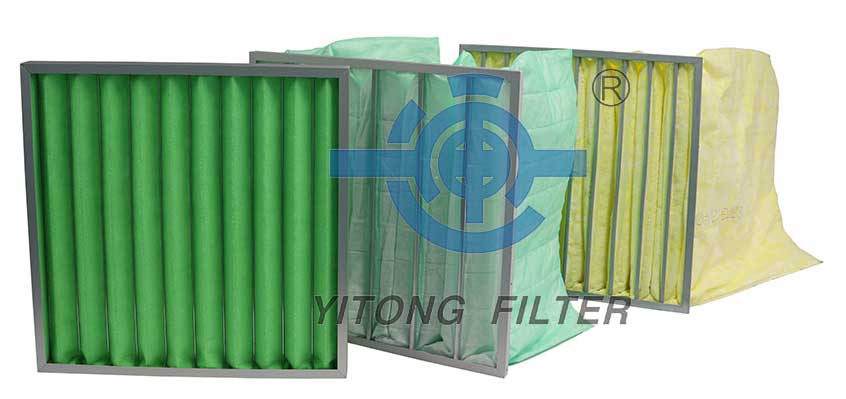
Panel filters are usually the first filter stage. They capture coarse debris before it reaches fans, coils, dampers, and more expensive filters. Pleated media provides more surface area than flat media, which can improve dust-holding capacity without increasing the face size.
Use panel or pleated pre-filters where the main objectives are equipment protection, low initial resistance, and economical replacement. They are especially important in dusty outdoor-air intakes and in systems where a downstream fine filter must achieve a reasonable service life.
Bag filters, also called pocket filters, use multiple media pockets to create a large filtration area. Their high dust-holding capacity makes them a common choice for commercial AHUs, industrial ventilation systems, and HVAC installations with sustained particle loading.
When comparing bag filters, review pocket length, number of pockets, media type, frame construction, air leakage control, and final pressure-drop recommendation. A bag filter with more media area is not automatically better; it must match the airflow and available space in the AHU.
Compact and V-bank filters are designed for applications requiring substantial media area in a shallow or space-constrained installation. Their rigid construction can suit systems with high airflow, variable air volume, or demanding mechanical conditions.
These filters are often used when a standard bag filter is too deep, when a high-capacity final filter is needed before HEPA filtration, or when lower replacement frequency is a priority. Confirm the rated airflow and initial pressure drop at the actual operating point rather than selecting only by nominal face dimensions.
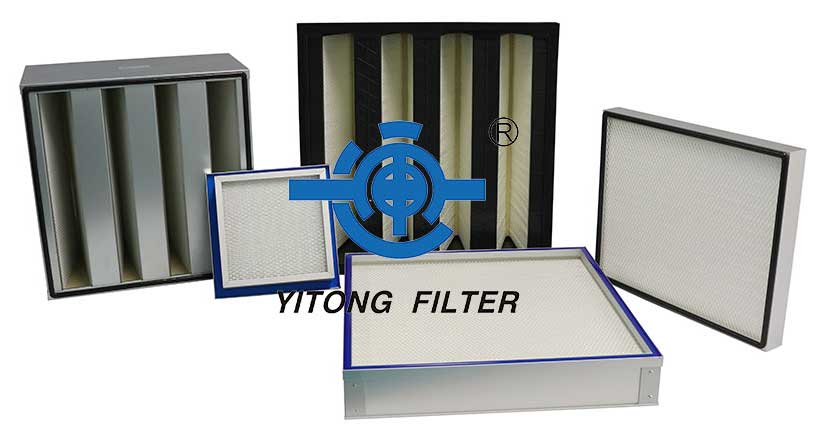
HEPA filters are used when the application requires very high particle-removal performance. Typical examples include cleanrooms, pharmaceutical production areas, hospitals, laboratories, electronics manufacturing, and other controlled environments.
HEPA should not normally be the first filtration stage in an AHU. Upstream pre-filtration and fine filtration reduce particulate loading, protect the HEPA media, and lower the total lifecycle cost. The final design should also address sealing, scan testing where required, pressure monitoring, and safe replacement procedures.
Particle filters do not reliably remove gases, odours, or volatile organic compounds. Where gas-phase contamination is a concern, an activated carbon filter can be added as a dedicated stage. The carbon type, bed depth, contact time, and target contaminant must be defined before selection.
AHU filter efficiency should be evaluated using the standard and test method applicable to the project. For ventilation filters, ISO 16890 is widely used. For high-efficiency particulate filters, EN 1822 and related standards are commonly referenced. Some projects may also use MERV classifications or historic EN 779 terminology; these should be translated carefully rather than treated as direct equivalents.
The most useful selection question is not simply “What is the highest efficiency?” It is: What particle size and cleanliness target must the system control at the lowest practical total cost?
An effective staged filtration design may include:
A pre-filter to capture coarse debris and protect equipment.
A fine filter to control smaller airborne particulate.
A HEPA final filter only where the application requires it.
A gas-phase filter when odours, VOCs, or chemical contaminants are part of the risk.
Higher efficiency can improve air cleanliness, but it can also increase pressure drop and energy demand. The best AHU filter is therefore a balance of filtration performance, airflow stability, replacement interval, and fan energy.
AHU filter size is more than width and height. A compatible filter must match the installation frame, depth, gasket arrangement, holding system, and operating airflow.
Before ordering, confirm these details:
Face dimensions: width and height of the filter frame.
Depth: available installation depth and any clearance needed for removal.
Rated airflow: airflow per filter and total airflow through the filter bank.
Face velocity: excessive velocity can raise resistance and reduce effective service life.
Frame and gasket: galvanized steel, plastic, aluminium, or other specified construction; gasket location must match the housing.
Filter-bank layout: number of filters across and high, blanking panels, and potential bypass paths.
Operating conditions: temperature, humidity, corrosive atmosphere, moisture exposure, and fire-safety requirements.
For example, two filters with the same face size may have very different airflow capacity because their media area, depth, and pleat geometry differ. Always compare the supplier’s performance data at the actual design airflow.
When requesting an AHU filter quotation or preparing a technical submittal, include the following specifications:
| Specification | Why it matters |
|---|---|
| Filtration class or efficiency standard | Defines the particle-removal performance required |
| Nominal dimensions and actual dimensions | Ensures fit with the housing and holding frame |
| Rated airflow | Confirms the filter can operate at the design duty |
| Initial pressure drop | Affects fan energy and available static pressure |
| Recommended final pressure drop | Helps plan replacement intervals and controls |
| Media type and construction | Influences dust holding, moisture resistance, and durability |
| Frame material and gasket | Supports mechanical fit and reduces bypass risk |
| Temperature and humidity limits | Confirms suitability for the operating environment |
| Compliance or test documentation | Supports project approval and quality assurance |
Pressure drop deserves particular attention. Initial pressure drop affects immediate fan energy, while final pressure drop determines when the filter should be changed. Replacing filters too early wastes usable media; replacing them too late can increase energy use, reduce airflow, and create a risk of filter damage or bypass.
Identify whether the AHU handles normal outdoor air, industrial dust, humid air, process contamination, medical environments, or sensitive manufacturing spaces. Define the expected particle load and whether gases or odours are also present.
Use the project specification, local code, process requirement, or cleanroom classification to identify the necessary filtration level. Avoid selecting an unnecessarily high final efficiency if a staged design can meet the actual requirement more efficiently.
Determine total airflow, airflow per filter, face velocity, and the fan static-pressure allowance. The filter bank must be evaluated as part of the complete AHU, not in isolation.
A typical commercial arrangement may use a pleated pre-filter plus a bag filter. A high-demand system may use a pre-filter, a compact fine filter, and a HEPA filter. Add activated carbon only when gas-phase contaminants are relevant.
Verify that the filters fit the housing and can be safely removed. Poor gasket compression, distorted frames, or incomplete filter-bank coverage can allow bypass air, reducing the actual performance of the system.
Install differential-pressure monitoring where practical. Establish replacement limits based on the filter manufacturer’s recommendation, system airflow requirements, and site operating experience.
Selecting by nominal size only and ignoring actual dimensions, depth, and gasket location.
Choosing the highest efficiency without reviewing pressure drop and fan capacity.
Using HEPA filtration without adequate upstream protection.
Ignoring air bypass around filter frames or through empty sections of the holding system.
Comparing filters only by purchase price instead of energy use and replacement frequency.
Mixing non-equivalent efficiency classifications without confirming the test standard.
Omitting gas-phase filtration where odours or VOCs are the real problem.
Most AHUs use a staged combination of pre-filters and fine filters. Applications with stricter cleanliness requirements may add compact filters, V-bank filters, HEPA filters, or activated carbon filters.
Replace AHU filters according to differential pressure, visible condition, airflow requirements, and the manufacturer’s recommended final pressure drop. A fixed calendar interval is useful for planning, but pressure monitoring provides a more reliable decision.
A bag filter uses flexible media pockets, while a V-bank filter uses rigid media packs arranged in a V configuration. V-bank filters can provide large media area in a compact depth and are often selected for high-airflow or space-limited AHUs.
Yes. AHUs serving cleanrooms, hospitals, laboratories, pharmaceutical areas, and other critical spaces may use HEPA filters as a final stage. Upstream pre-filtration and fine filtration are important to protect the HEPA filter and maintain stable system performance.
The most energy-efficient option is the filter configuration that meets the required air-quality target with the lowest practical resistance over its service life. Compare initial pressure drop, dust-holding capacity, change-out pressure, airflow, and fan energy—not just initial purchase price.
For an accurate recommendation, provide your AHU airflow, existing filter dimensions, installation depth, target efficiency, operating environment, and any limits on pressure drop. A properly matched staged filtration system can protect equipment, improve indoor-air quality, and control lifecycle cost.
Yitong Filter can support AHU filter selection for ventilation, industrial air filtration, cleanroom, and specialized HVAC applications.